
Control Plane HA is a complete high availability Kubernetes cluster. This deployment requires three Control Plane nodes and two or more Worker nodes.
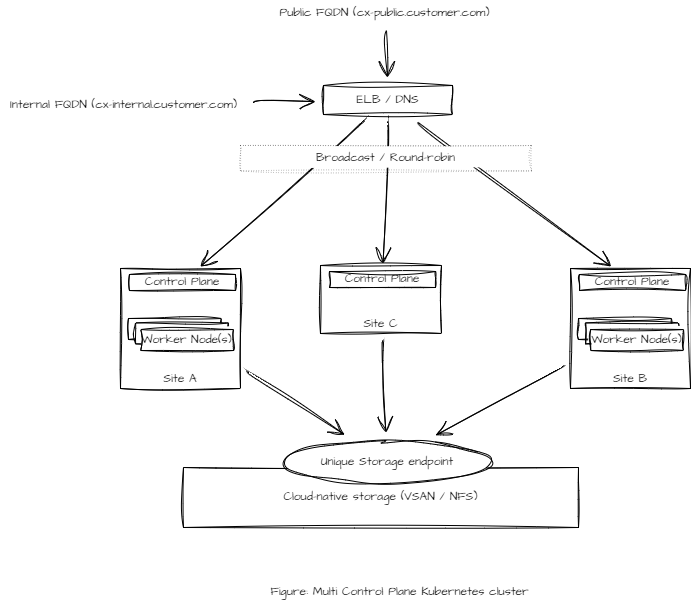
Suitable when
-
Three sites are available for the cluster deployment. In addition to a primary and a secondary site, a third site for Control Plane is required to complete the quorum.
-
Site level redundancy is needed.
Recommendations
-
Provide a cloud-native storage such as NFS, VSAN, or any CNCF certified cloud-native storage accessible at both sites. Though, CX may be deployed on a Kubernetes cluster where the underlying storage is not a cloud-native storage.
Limitations
-
Out of three control plane nodes, at least two nodes must always be up and connected for the cluster to function.
Deployment Prerequisites
-
At least three nodes (typically virtual machines) - one for Control Plane and two or more for worker nodes.
-
Full network connectivity between all node
Network topology
For load balancing of control planes, consider any of the following three options.
|
External Load Balancer (ELB) |
A Load balancer is used for routing the traffic to the Kubernetes cluster. For a layer-7 load balancer, you may use:
For setting up an HA cluster using external load balancer, see High Availability using External Load Balancer |
|---|---|
|
KubeVIP |
Kube-vip provides Kubernetes clusters with a virtual IP and load balancer for both the control plane (for building a highly-available cluster) and Kubernetes Services of type LoadBalancer without relying on any external hardware or software.High Availability with Kube-VIP |
|
DNS |
DNS can be configured to point all the traffic of a domain to any of the needed Control-Plane Nodes High Availability with DNS |