
This document provides Operations Managers with the technical framework required to maintain the health, stability, and security of the contact center solution. It serves as a guide to:
-
Provide clear visibility into how audit logging and tracing are implemented across the CX stack.
-
Enable rapid investigation of agent, supervisor, and system activities (who did what, when, and from where)
-
Support troubleshooting of customer interactions and call flows by correlating logs and traces across services
-
Facilitate compliance, security, and governance checks by ensuring that all critical actions are traceable and verifiable on demand.
CX platform uses OpenTelemetry Protocol (OTLP) based logs and traces for real-time observability, secure auditability, and end-to-end traceability utilizing a vendor-agnostic SIEM solution. Expertflow CX works with OpenSearch for observability but it can work with other enterprise SIEM solutions.
Components with Working Audit Logs
-
CIM Customer
-
CCM
-
Routing engine
-
Team announcement
-
Unified admin
-
CX tenant
-
Keycloak
-
License manager
-
Bot connectors
-
Load Hub
-
Campaigns
Architecture
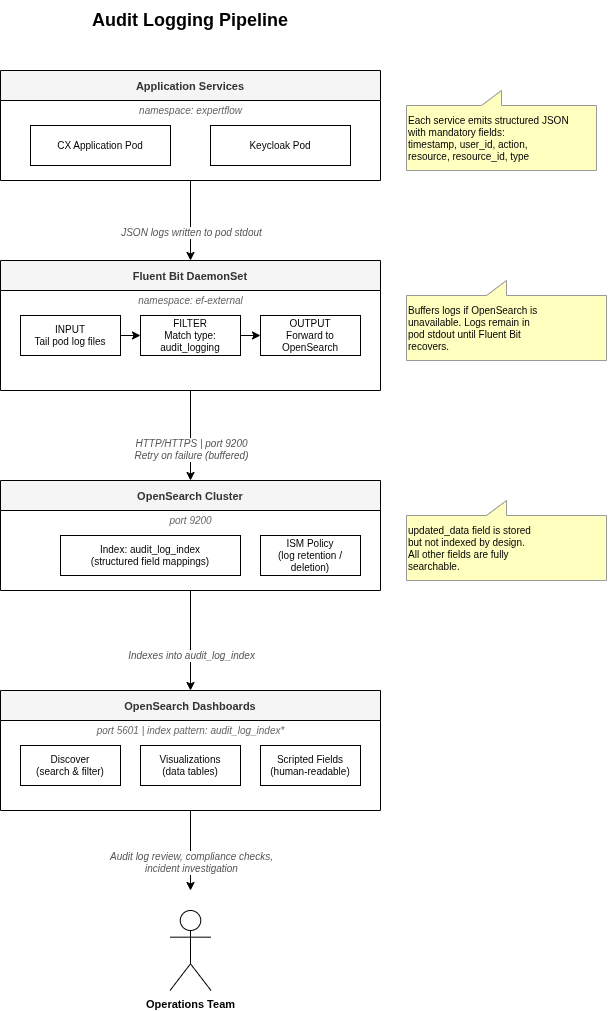
Each component runs independently. If OpenSearch is unavailable, Fluent Bit buffers logs and retries. If Fluent Bit is down, logs remain in the pod output until it recovers.
-
Architecture document: Logging and Tracing Architecture
Core Objectives
Our logging strategy is built upon the following functional pillars:
-
Observability: Deliver real-time insight into application health and operational behavior
-
Debugging: Enable fast identification of failures and anomalies
-
Performance Monitoring: Analyze latency, throughput, and service bottlenecks
-
Auditability: Capture and retain critical actions for security and compliance
-
Correlation: Link logs, traces, and metrics using trace and span identifiers
Key Security and Data Integrity Principles
To maintain evidentiary value and system trust, all audit records adhere to the following mandates:
-
Immutability: Records are append-only; once written, they cannot be altered or deleted.
-
Chronological Integrity: Events are stored in the order of occurrence
-
Context Awareness: Each record contains sufficient metadata for interpretation
-
Trace Correlation: Logs and audit records can be linked to execution traces
Compliance Value
Audit logging creates the forensic paper trail needed to meet global security standards. It converts raw system activity into verifiable evidence of accountability.
|
Framework |
Core Requirement |
Strategic Value |
|
SOC 2 |
Trust Service Criteria |
Ensures traceability of admin actions, availability of logs during failures, and confidentiality of log storage. |
|
ISO 27001 |
Control A.12.4 |
Enables event traceability across all resources and provides empirical evidence for incident analysis. |
|
HIPAA |
§164.312(b) |
Mandates recording access to ePHI; essential for detecting unauthorized disclosures and forensic breach notification. |
|
GDPR |
Articles 30 & 33 |
Demonstrates accountability in data processing and facilitates the 72-hour breach reporting window. |
|
PCI DSS |
Requirement 10 |
Mandates tracking all access to cardholder data (CHD) to detect policy violations and suspicious network activity. |
Universal Security Benefits
-
Incident Response: Provides the telemetry needed to reconstruct the timeline of a security event.
-
Non-Repudiation: Ensures that a user cannot deny performing a specific action within the system.
-
Anomaly Detection: Establishes a baseline of "normal" behavior to highlight unauthorized administrative shifts.
Before You Begin
Confirm all of the following before starting the setup sequence:
-
Kubernetes cluster is running and you have
kubectlaccess -
Helm is installed (version 3.x or later)
-
The
expertflownamespace exists and application pods are running -
The
ef-externalnamespace exists or you have permissions to create it -
You have an OpenSearch instance accessible at a known host or IP address
-
You have OpenSearch admin credentials (username and password)
-
You have permissions to create Kubernetes namespaces and deploy Helm charts
-
CX solution is running; all pods are up and healthy
-
Audit logs for keycloak is enabled Enablement Guide For Keycloak Audit Logging and Events Tracing
How to proceed with deployment
Deploy OpenSearch first, then configure it. Next, deploy Fluent Bit and verify the pipeline. Begin with the Audit logs deployment with OpenSearch document below, which contains all relevant instructions for enabling logging via OpenSearch.
-
Audit logs deployment with opensearch: Logging and Tracing Integration with OpenSearch
Operations team can access the logs from Kubernetes Pods using this guide