
This document illustrates the procedure and steps to deploy MS-CRM-Connector on Kubernetes.
Before you begin, verify
- Installed Kubernetes. If not, see Deployment Planning
- Have already setup storage. If not yet, see Storage Solution - Getting Started
Prepare for MS-CRM-Connector-Cif-2.0 Deployments
Step 1: Clone the MS-CRM-Connector-Cif-2.0 repository
git clone -b <branch Name> https://gitlab.expertflow.com/cti/ms-crm-connector-with-efcx-cif-2.0.git
cd ms-crm-connector-with-efcx-cif-2.0/
Step 2: Create Namespaces
-
Create a namespace
expertflow.
kubectl create namespace expertflow
Step 3: Apply Image Pull secret
-
Run the following commands for applying ImagePullSecrets of ms-crm-connector images.
kubectl apply -f kubernetes/registryCredits/ms-imagePullSecret-expertflow.yaml
Step 4: Update FQDN
MS-CRM-Connector should be accessible by a fully qualified domain name. Assign the FQDN.
Replace <FQDN> with your FQDN for wfm-reports and run this command.
sed -i 's/devops[0-9]*.ef.com/<FQDN>/g' kubernetes/ConfigMaps/* kubernetes/Ingresses/nginx/* kubernetes/Ingresses/traefik/*
Update Config Map
-
Open the ConfigMap
nano <FQDN>/kubernetes/ConfigMaps/ms-crm-cif-2.0-configmap.yaml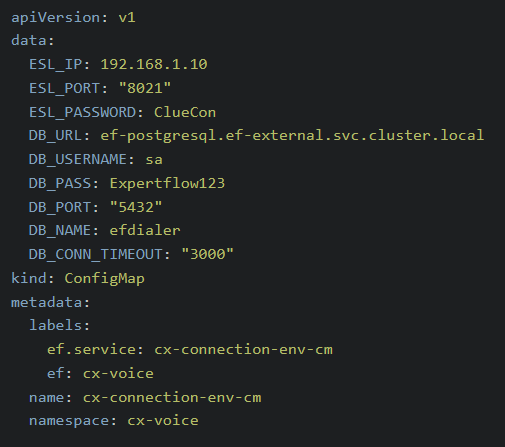
-
Change the values as follows:
-
AGENTDESK: URL to the Agent Desk
-
ENTITIES: contact, account, lead
-
NOMATCHENTITY: Account
-
ORGANIZATIONDOMAIN: URL of CRM
-
-
Exit the editor by pressing the ctrl+X key and then entering
Shift+Y
Step 5: Deploy MS-CRM-Connector Change the directory
-
Change the directory
cd kubernetes/
-
Apply ConfigMaps
kubectl apply -f ConfigMaps/ms-crm-cif-2.0-configmap.yaml -
Create services for ms-crm-cif-2
kubectl apply -f Services/ms-crm-cif-2.0-service.yaml -
Apply the Deployment manifest
kubectl apply -f Deployments/ms-crm-cif-2.0-deployment.yaml -
Before proceeding to the the next steps, wait for all the solution components to be up and ready.
kubectl get pods -n expertflow
Step 6 :Setup Ingress Routes
For RKE2-based Ingresses using Ingress-Nginx Controller
kubectl apply -f Ingresses/nginx/ms-crm-cif-2.0-Ingress.yaml