This guide is intended for operations and web administration teams. It provides a structured, step-by-step procedure for deploying OpenSearch and OpenSearch Dashboards to ensure reliable and scalable log retention.
Step 1: Deploy the Opensearch and Opensearch Dashboards
Create a shell script to deploy OpenSearch and OpenSearch Dashboards using the following command:-
vi deploy_opensearch.sh
Copy the following content and paste it into the shell script.
#!/bin/bash

# ==============================================================================
# Automated OpenSearch & Dashboards Deployment & Management Script
#
# Version: 2.2
# Release Date: 2025-07-29
#
# This script automates the installation, configuration, and management of a
# single-node OpenSearch cluster and Dashboards. It includes robust error
# handling, idempotency checks, and lifecycle management features.
#
# ==============================================================================

# --- Script Setup ---
# Exit on any error, and on unset variables.
set -euo pipefail

# --- Global Variables ---
LOG_FILE="/tmp/opensearch_deploy.log"
INSTALL_NGINX_PROXY=false
FQDN=$(hostname -f 2>/dev/null || echo "$(hostname)")
OPENSEARCH_URL="https://localhost:9200"
PASSWORD_FILE="/etc/opensearch/.admin_password"

# --- Helper & Execution Functions ---

# Clear log file at the start of the script
rm -f "$LOG_FILE"

# Centralized command execution function
execute() {
    local cmd="$1"
    local msg="$2"
    local mode="${3:-quiet}"

    echo -n "=> $msg... "

    if [ "$mode" == "verbose" ]; then
        echo " (running...)"
        # Execute command with live output, appending to log file
        if sudo -E bash -c "$cmd" 2> >(tee -a "$LOG_FILE" >&2) | tee -a "$LOG_FILE"; then
            echo -n "=> $msg... "
            echo -e "\e[32mOK\e[0m"
        else
            echo -n "=> $msg... "
            echo -e "\e[31mFAILED\e[0m"
            echo "--------------------- ERROR LOG ----------------------" >&2
            echo "Error details were logged above and also saved to $LOG_FILE" >&2
            echo "------------------------------------------------------" >&2
            exit 1
        fi
    else
        # Execute command quietly, appending to log file
        if sudo -E bash -c "$cmd" >> "$LOG_FILE" 2>&1; then
            echo -e "\e[32mOK\e[0m"
        else
            echo -e "\e[31mFAILED\e[0m"
            echo "--------------------- ERROR LOG ----------------------" >&2
            cat "$LOG_FILE" >&2
            echo "------------------------------------------------------" >&2
            exit 1
        fi
    fi
}

# Function to execute curl commands against OpenSearch API
execute_curl() {
    local method="$1"
    local endpoint="$2"
    local data="$3"
    local msg="$4"

    # Get admin password from file or prompt if it doesn't exist
    if [ -z "${OPENSEARCH_ADMIN_PASSWORD:-}" ]; then
        if [ -f "$PASSWORD_FILE" ]; then
            OPENSEARCH_ADMIN_PASSWORD=$(sudo cat "$PASSWORD_FILE")
        else
            read -sp "Enter OpenSearch 'admin' password: " OPENSEARCH_ADMIN_PASSWORD
            echo
        fi
    fi

    local cmd="curl -s -k -w '\n%{http_code}' -u 'admin:${OPENSEARCH_ADMIN_PASSWORD}' -X ${method} '${OPENSEARCH_URL}${endpoint}' -H 'Content-Type: application/json' -d '${data}'"

    echo -n "=> $msg... "

    # Execute command and capture output and http_code
    local response
    response=$(eval "$cmd")
    local http_code
    http_code=$(echo "$response" | tail -n1)
    local body
    body=$(echo "$response" | sed '$d')

    if [[ "$http_code" -ge 200 && "$http_code" -lt 300 ]]; then
        echo -e "\e[32mOK ($http_code)\e[0m"
        echo "$body" >> "$LOG_FILE"
    else
        echo -e "\e[31mFAILED ($http_code)\e[0m"
        echo "--------------------- ERROR LOG ----------------------" >&2
        echo "$body" >&2
        echo "------------------------------------------------------" >&2
        exit 1
    fi
}


log() {
    echo "--------------------------------------------------"
    echo "=> $1"
    echo "--------------------------------------------------"
}

usage() {
    echo "OpenSearch & Dashboards Deployment & Management Script (v2.2)"
    echo ""
    echo "Usage: $0 [COMMAND] [OPTIONS]"
    echo ""
    echo "Commands:"
    echo "  install [--with-nginx] [--password <pass>] Install OpenSearch and Dashboards."
    echo "  status                        Show details of the current installation."
    echo ""
    echo "  ism-create-interactive        Interactively create a simple ISM policy."
    echo "  ism-policy-apply              Create or update an ISM policy from a JSON file."
    echo "      --name <policy_name>      (Required) The name of the policy."
    echo "      --file <path_to.json>     (Required) Path to the policy JSON file."
    echo "  ism-policy-get                View a specific ISM policy."
    echo "      --name <policy_name>      (Required) The name of the policy to view."
    echo "  ism-policy-delete             Delete an ISM policy."
    echo "      --name <policy_name>      (Required) The name of the policy to delete."
    echo "  ism-policy-list               List all existing ISM policies."
    echo ""
    echo "  ism-attach                    Attach a policy to a specific index."
    echo "      --policy <policy_name>    (Required) The policy to attach."
    echo "      --index <index_name>      (Required) The index to attach to."
    echo "  ism-remove                    Remove a policy from an index."
    echo "      --index <index_name>      (Required) The index to remove from."
    echo ""
    echo "  --enable-nginx                Enable Nginx reverse proxy after installation."
    echo "  --disable-nginx               Disable Nginx reverse proxy."
    echo "  --uninstall                   Uninstall the entire OpenSearch stack."
    echo "  --help                        Display this help message."
    echo ""
}

# --- Core Logic Functions ---

detect_os() {
    if [ -f /etc/os-release ]; then
        . /etc/os-release
        OS_ID=$ID
    else
        execute "false" "Cannot detect OS distribution."
    fi
}

#preflight_checks() {
#    log "Running pre-flight checks"
#    local missing_packages=()
#    for pkg in curl gpg jq; do
#        if ! command -v $pkg &> /dev/null; then
#            missing_packages+=($pkg)
#        fi
#    done
#    if [ ${#missing_packages[@]} -gt 0 ]; then
#        echo "Error: Required packages are missing: ${missing_packages[*]}" >&2
#        echo "Please install them and run the script again." >&2
#        exit 1
#    fi
#    echo "=> All required packages are present."
#}

#fix_apt_sources() {
#    log "Checking and optimizing APT sources"
#    local sources_files
#    # Get a list of all apt source files that contain a regional mirror URL
#    sources_files=$(grep -lE "[a-z]{2}\.archive\.ubuntu\.com" /etc/apt/sources.list /etc/apt/sources.list.d/*.list 2>/dev/null || true)

#    if [ -n "$sources_files" ]; then
#        echo "Regional mirror detected. Switching to the main global repository."
#        for file in $sources_files; do
#            execute "cp ${file} ${file}.bak" "Backing up ${file}"
#            execute "sed -i -E 's/([a-z]{2}\\.)?archive\\.ubuntu\\.com/archive.ubuntu.com/g' ${file}" "Updating ${file}"
#        done
#        echo "Switched to main Ubuntu repository to prevent regional mirror issues."
#    else
#        echo "=> APT sources appear to be using the main repository already. No changes needed."
#    fi
#}


apply_prerequisites() {
    log "Applying universal system prerequisites"
    if ! grep -q "vm.max_map_count=262144" /etc/sysctl.conf; then
        execute "echo 'vm.max_map_count=262144' | tee -a /etc/sysctl.conf" "Setting vm.max_map_count"
        execute "sysctl -p" "Applying new sysctl config"
    else
        echo "=> Setting vm.max_map_count... SKIPPED (already set)"
    fi
    execute "swapoff -a" "Disabling swap"
    execute "sed -i '/ swap / s/^\(.*\)$/#\1/g' /etc/fstab" "Making swap disable persistent"
}

configure_jvm_heap() {
    log "Configuring JVM heap size to 4GB"
    execute "mkdir -p /etc/opensearch/jvm.options.d" "Creating jvm.options.d directory"
    execute "echo -e '# Set the initial and maximum heap size to the same value\n-Xms4g\n-Xmx4g' | tee /etc/opensearch/jvm.options.d/heap.options" "Writing heap options file"
}

deploy_debian() {
    log "Starting deployment for Debian/Ubuntu"
    #fix_apt_sources
    #execute "apt-get update && apt-get upgrade -y" "Updating system packages" "verbose"
    #execute "apt-get install -y curl gnupg lsb-release ca-certificates apt-transport-https" "Installing dependencies"
    execute "curl -fsSL https://artifacts.opensearch.org/publickeys/opensearch.pgp | gpg --dearmor -o /etc/apt/trusted.gpg.d/opensearch.gpg" "Importing OpenSearch GPG key"
    execute "echo 'deb https://artifacts.opensearch.org/releases/bundle/opensearch/2.x/apt stable main' | tee /etc/apt/sources.list.d/opensearch-2.x.list" "Adding OpenSearch repository"
    execute "echo 'deb https://artifacts.opensearch.org/releases/bundle/opensearch-dashboards/2.x/apt stable main' | tee -a /etc/apt/sources.list.d/opensearch-2.x.list" "Adding Dashboards repository"
    #execute "apt-get update" "Refreshing package lists"

    export OPENSEARCH_INITIAL_ADMIN_PASSWORD
    execute "apt-get install -y opensearch opensearch-dashboards" "Installing OpenSearch and Dashboards"

    if [ "$INSTALL_NGINX_PROXY" = true ]; then
        execute "apt-get install -y nginx" "Installing Nginx"
    fi
}

deploy_rhel() {
    log "Starting deployment for RHEL/CentOS/Rocky"
    execute "dnf update -y" "Updating system packages" "verbose"
    execute "dnf install -y curl gnupg" "Installing dependencies"
    execute "curl -SL https://artifacts.opensearch.org/releases/bundle/opensearch/2.x/opensearch-2.x.repo -o /etc/yum.repos.d/opensearch-2.x.repo" "Adding OpenSearch repository"
    execute "curl -SL https://artifacts.opensearch.org/releases/bundle/opensearch-dashboards/2.x/opensearch-dashboards-2.x.repo -o /etc/yum.repos.d/opensearch-dashboards-2.x.repo" "Adding Dashboards repository"
    execute "dnf clean all" "Cleaning DNF cache"

    export OPENSEARCH_INITIAL_ADMIN_PASSWORD
    execute "dnf install -y opensearch opensearch-dashboards" "Installing OpenSearch and Dashboards"

    if [ "$INSTALL_NGINX_PROXY" = true ]; then
        execute "dnf install -y nginx" "Installing Nginx"
    fi
}

configure_opensearch() {
    log "Configuring OpenSearch"
    cat <<EOF | sudo tee -a /etc/opensearch/opensearch.yml > /dev/null

# --- Script Modifications ---
network.host: 0.0.0.0
discovery.type: single-node
EOF
    echo "=> Appending network settings to opensearch.yml... OK"
}

configure_dashboards() {
    log "Configuring OpenSearch Dashboards"
    local dashboards_host="0.0.0.0"
    if [ "$INSTALL_NGINX_PROXY" = true ]; then
        dashboards_host="127.0.0.1"
    fi

    # Overwrite the config file with a minimal, correct version
    export CONFIG_CONTENT
    CONFIG_CONTENT=$(cat <<EOF
# OpenSearch Dashboards configuration file, managed by script.

server.host: "${dashboards_host}"
opensearch.hosts: ["https://localhost:9200"]
opensearch.ssl.verificationMode: none
opensearch.username: "admin"
opensearch.password: "${OPENSEARCH_INITIAL_ADMIN_PASSWORD}"
opensearch_security.cookie.secure: false
EOF
)
    execute 'echo "$CONFIG_CONTENT" | tee /etc/opensearch-dashboards/opensearch_dashboards.yml' "Writing opensearch_dashboards.yml"
    unset CONFIG_CONTENT
}

configure_nginx_proxy() {
    log "Configuring Nginx as a reverse proxy for Dashboards"
    execute "mkdir -p /etc/nginx/ssl" "Creating Nginx SSL directory"
    execute "openssl req -x509 -nodes -days 365 -newkey rsa:2048 -keyout /etc/nginx/ssl/opensearch_dashboards.key -out /etc/nginx/ssl/opensearch_dashboards.crt -subj '/C=US/ST=State/L=City/O=Organization/CN=${FQDN}'" "Generating self-signed SSL certificate"

    export NGINX_CONFIG
    NGINX_CONFIG=$(cat <<EOF
server {
    listen 80;
    server_name ${FQDN};
    return 301 https://\$host\$request_uri;
}
server {
    listen 443 ssl http2;
    server_name ${FQDN};
    ssl_certificate /etc/nginx/ssl/opensearch_dashboards.crt;
    ssl_certificate_key /etc/nginx/ssl/opensearch_dashboards.key;
    ssl_protocols TLSv1.2 TLSv1.3;
    ssl_ciphers HIGH:!aNULL:!MD5;
    location / {
        proxy_pass http://127.0.0.1:5601;
        proxy_set_header Host \$host;
        proxy_set_header X-Real-IP \$remote_addr;
        proxy_set_header X-Forwarded-For \$proxy_add_x_forwarded_for;
        proxy_set_header X-Forwarded-Proto \$scheme;
        proxy_http_version 1.1;
        proxy_set_header Connection "upgrade";
        proxy_set_header Upgrade \$http_upgrade;
        proxy_read_timeout 90s;
    }
}
EOF
)
    execute 'echo "$NGINX_CONFIG" | tee /etc/nginx/conf.d/opensearch-dashboards.conf' "Writing Nginx config file"
    unset NGINX_CONFIG
    execute "nginx -t" "Testing Nginx configuration"
    execute "systemctl enable nginx" "Enabling Nginx service"
    execute "systemctl restart nginx" "Restarting Nginx service"
}

start_services() {
    log "Starting and enabling services"
    execute "systemctl daemon-reload" "Reloading systemd daemon"
    execute "systemctl enable opensearch" "Enabling OpenSearch service"
    execute "systemctl start opensearch" "Starting OpenSearch service"

    # Wait for OpenSearch to be ready
    echo -n "=> Waiting for OpenSearch to initialize..."
    local retries=30
    local count=0
    while ! curl -s -k -u "admin:${OPENSEARCH_INITIAL_ADMIN_PASSWORD}" "$OPENSEARCH_URL" > /dev/null; do
        if [ $count -ge $retries ]; then
            echo -e "\e[31m FAILED\e[0m"
            echo "OpenSearch did not start in time. Please check the logs." >&2
            exit 1
        fi
        echo -n "."
        sleep 2
        ((count++))
    done
    echo -e "\e[32m OK\e[0m"

    execute "systemctl enable opensearch-dashboards" "Enabling Dashboards service"
    execute "systemctl start opensearch-dashboards" "Starting Dashboards service"
}

# --- Main Functions for User Actions ---

generate_password() {
    # Generate a 16-character password. Use openssl if available, fallback to urandom.
    if command -v openssl &> /dev/null; then
        openssl rand -base64 12
    else
        LC_ALL=C tr -dc 'A-Za-z0-9!#%&()*+,-./:;<=>?@[]^_{|}~' < /dev/urandom | head -c 16
    fi
}

run_installation() {
    log "Starting OpenSearch Installation"

    if command -v opensearch &> /dev/null; then
        echo "OpenSearch appears to be already installed. Please uninstall first or use other management commands." >&2
        exit 1
    fi

    # Handle password
    if [ -n "${USER_PASSWORD:-}" ]; then
        OPENSEARCH_INITIAL_ADMIN_PASSWORD=$USER_PASSWORD
        echo "=> Using user-provided password."
    else
        OPENSEARCH_INITIAL_ADMIN_PASSWORD=$(generate_password)
        echo "=> Generated a secure random password."
    fi

    detect_os
    #preflight_checks
    apply_prerequisites

    if [ "$OS_ID" = "ubuntu" ] || [ "$OS_ID" = "debian" ]; then
        deploy_debian
    elif [ "$OS_ID" = "rhel" ] || [ "$OS_ID" = "centos" ] || [ "$OS_ID" = "rocky" ]; then
        deploy_rhel
    else
        execute "false" "Unsupported OS: $OS_ID"
    fi

    configure_opensearch
    configure_jvm_heap
    configure_dashboards

    if [ "$INSTALL_NGINX_PROXY" = true ]; then
        configure_nginx_proxy
    fi

    start_services

    # Securely store the password
    execute "mkdir -p /etc/opensearch" "Creating /etc/opensearch directory"
    execute "echo \"$OPENSEARCH_INITIAL_ADMIN_PASSWORD\" | tee $PASSWORD_FILE" "Storing admin password"
    execute "chmod 600 $PASSWORD_FILE" "Securing password file"

    local primary_ip
    primary_ip=$(hostname -I | awk '{print $1}')

    log "Deployment Complete!"
    echo "=================================================="
    if [ -z "${USER_PASSWORD:-}" ]; then
        echo "OpenSearch Admin Password: ${OPENSEARCH_INITIAL_ADMIN_PASSWORD}"
    else
        echo "OpenSearch Admin Password: [USER PROVIDED]"
    fi

    if [ "$INSTALL_NGINX_PROXY" = true ]; then
        echo "Access OpenSearch Dashboards at: https://${primary_ip}"
        echo
        echo "NOTE: The self-signed SSL certificate was issued for the hostname '${FQDN}'."
        echo "You will receive a browser security warning. This is expected."
    else
        echo "Access OpenSearch Dashboards at: http://${primary_ip}:5601"
    fi
    echo "=================================================="
}

run_uninstall() {
    log "Uninstalling OpenSearch Stack"
    echo -e "\n\e[1;31m!!!!!!!!!!!!!!!!!!!!!!!!!!!!!! WARNING !!!!!!!!!!!!!!!!!!!!!!!!!!!!!!"
    echo "This operation is IRREVERSIBLE."
    echo "It will permanently delete:"
    echo "  - OpenSearch, Dashboards, and Nginx packages."
    echo "  - All configuration files."
    echo "  - ALL DATA AND INDEXES stored in OpenSearch (/var/lib/opensearch)."
    echo -e "!!!!!!!!!!!!!!!!!!!!!!!!!!!!!!!!!!!!!!!!!!!!!!!!!!!!!!!!!!!!!!!!!!!!\e[0m\n"
    read -p "To confirm this destructive action, type 'yes-delete-all-data': " confirm
    if [ "$confirm" != "yes-delete-all-data" ]; then
        echo "Uninstallation cancelled."
        exit 1
    fi

    detect_os
    execute "systemctl stop opensearch opensearch-dashboards nginx || true" "Stopping services"
    execute "systemctl disable opensearch opensearch-dashboards nginx || true" "Disabling services"

    if [ "$OS_ID" = "ubuntu" ] || [ "$OS_ID" = "debian" ]; then
        execute "apt-get purge -y opensearch opensearch-dashboards nginx" "Purging packages"
        execute "apt-get autoremove --purge -y" "Removing orphaned dependencies"
        execute "rm -f /etc/apt/sources.list.d/opensearch-2.x.list" "Removing repository file"
        execute "find /etc/apt/ -name '*.bak' -delete" "Removing repository backup files"
    elif [ "$OS_ID" = "rhel" ] || [ "$OS_ID" = "centos" ] || [ "$OS_ID" = "rocky" ]; then
        execute "dnf remove -y opensearch opensearch-dashboards nginx" "Removing packages"
        execute "rm -f /etc/yum.repos.d/opensearch-2.x.repo /etc/yum.repos.d/opensearch-dashboards-2.x.repo" "Removing repository files"
    fi

    execute "rm -rf /etc/opensearch /etc/opensearch-dashboards /var/lib/opensearch" "Removing data and config directories"
    execute "rm -rf /etc/nginx/conf.d/opensearch-dashboards.conf /etc/nginx/ssl" "Removing Nginx config"
    execute "sed -i '/vm.max_map_count=262144/d' /etc/sysctl.conf && sysctl -p" "Reverting kernel parameters"
    execute "rm -f $LOG_FILE" "Removing log file"
    log "Uninstallation complete."
}

run_enable_nginx() {
    log "Enabling Nginx Reverse Proxy"
    detect_os

    if ! command -v nginx &> /dev/null; then
        if [ "$OS_ID" = "ubuntu" ] || [ "$OS_ID" = "debian" ]; then
            execute "apt-get update && apt-get install -y nginx" "Installing Nginx" "verbose"
        elif [ "$OS_ID" = "rhel" ] || [ "$OS_ID" = "centos" ] || [ "$OS_ID" = "rocky" ]; then
            execute "dnf install -y nginx" "Installing Nginx" "verbose"
        fi
    fi

    execute "sed -i 's/server.host:.*/server.host: \"127.0.0.1\"/' /etc/opensearch-dashboards/opensearch_dashboards.yml" "Configuring Dashboards for local listening"
    configure_nginx_proxy
    execute "systemctl restart opensearch-dashboards" "Restarting Dashboards service"

    log "Nginx proxy has been enabled."
    echo "Access Dashboards at: https://$(hostname -I | awk '{print $1}')"
}

run_disable_nginx() {
    log "Disabling Nginx Reverse Proxy"
    execute "systemctl stop nginx || true" "Stopping Nginx"
    execute "systemctl disable nginx || true" "Disabling Nginx"
    execute "rm -f /etc/nginx/conf.d/opensearch-dashboards.conf" "Removing Nginx config"
    execute "rm -rf /etc/nginx/ssl" "Removing Nginx SSL directory"
    execute "sed -i 's/server.host:.*/server.host: \"0.0.0.0\"/' /etc/opensearch-dashboards/opensearch_dashboards.yml" "Configuring Dashboards for public listening"
    execute "systemctl restart opensearch-dashboards" "Restarting Dashboards service"

    log "Nginx proxy has been disabled."
    echo "Access Dashboards at: http://$(hostname -I | awk '{print $1'}):5601"
}

# --- ISM Management Functions ---

run_ism_create_interactive() {
    log "Interactive ISM Policy Creator"
    read -p "Enter a name for the new policy (e.g., 30-day-delete): " policy_name
    read -p "Enter the index pattern this policy will apply to (e.g., my-logs-*): " index_pattern
    read -p "Enter number of days for the 'hot' phase (e.g., 7): " hot_days

    local policy_json
    policy_json=$(cat <<EOF
{
    "policy": {
        "description": "A simple hot-to-delete policy.",
        "default_state": "hot",
        "states": [
            {
                "name": "hot",
                "actions": [ { "rollover": { "min_index_age": "${hot_days}d" } } ],
                "transitions": [ { "state_name": "delete" } ]
            },
            { "name": "delete", "actions": [ { "delete": {} } ] }
        ],
        "ism_template": { "index_patterns": ["${index_pattern}"], "priority": 100 }
    }
}
EOF
)
    execute_curl "PUT" "/_plugins/_ism/policies/${policy_name}" "$policy_json" "Creating ISM policy '${policy_name}'"
    echo "ISM Policy '${policy_name}' created. It will apply to new indices matching '${index_pattern}'."
}

run_ism_policy_apply() {
    if [ ! -f "$POLICY_FILE" ]; then execute "false" "Policy file not found at '$POLICY_FILE'"; fi
    local policy_json
    policy_json=$(cat "$POLICY_FILE")
    execute_curl "PUT" "/_plugins/_ism/policies/${POLICY_NAME}" "$policy_json" "Applying policy '${POLICY_NAME}' from file"
    echo "Policy '${POLICY_NAME}' has been created/updated."
}

run_ism_policy_get() {
    log "Fetching ISM Policy: ${POLICY_NAME}"
    execute_curl "GET" "/_plugins/_ism/policies/${POLICY_NAME}" "" "Fetching policy '${POLICY_NAME}'"
    echo "--- Policy Details for ${POLICY_NAME} ---"
    cat "$LOG_FILE" | sed '$d' | jq .
    echo "------------------------------------"
}

run_ism_policy_delete() {
    log "Deleting ISM Policy: ${POLICY_NAME}"
    read -p "Are you sure you want to delete the policy '${POLICY_NAME}'? (y/n): " confirm
    if [ "$confirm" != "y" ]; then echo "Deletion cancelled."; exit 1; fi
    execute_curl "DELETE" "/_plugins/_ism/policies/${POLICY_NAME}" "" "Deleting policy '${POLICY_NAME}'"
    echo "Policy '${POLICY_NAME}' deleted."
}

run_ism_policy_list() {
    log "Listing all ISM Policies"
    execute_curl "GET" "/_plugins/_ism/policies/" "" "Listing all policies"
    echo "--- All ISM Policies ---"
    cat "$LOG_FILE" | sed '$d' | jq .
    echo "------------------------"
}

run_ism_attach() {
    log "Attaching policy '${POLICY_NAME}' to index '${INDEX_NAME}'"
    local data
    data="{\"policy_id\": \"${POLICY_NAME}\"}"
    execute_curl "POST" "/_plugins/_ism/add/${INDEX_NAME}" "$data" "Attaching policy"
    echo "Policy attached."
}

run_ism_remove() {
    log "Removing policy from index '${INDEX_NAME}'"
    execute_curl "POST" "/_plugins/_ism/remove/${INDEX_NAME}" "" "Removing policy"
    echo "Policy removed."
}

run_status() {
    log "Fetching Installation Status"
    if [ ! -f "$PASSWORD_FILE" ]; then
        echo "Could not find password file at '$PASSWORD_FILE'." >&2
        echo "Status cannot be determined. The installation may be incomplete or the password was not saved." >&2
        exit 1
    fi
    local password
    password=$(sudo cat "$PASSWORD_FILE")

    local url
    if [ -f /etc/nginx/conf.d/opensearch-dashboards.conf ]; then
        url="https://$(hostname -I | awk '{print $1}')"
    else
        url="http://$(hostname -I | awk '{print $1'}):5601"
    fi

    echo "--- OpenSearch Installation Details ---"
    echo "Dashboard URL: $url"
    echo "Admin User:    admin"
    echo "Admin Password: $password"
    echo "---------------------------------------"
}

# --- Script Entrypoint ---

# Check for root privileges
if [ "$EUID" -ne 0 ]; then
  echo "Please run this script as root or with sudo." >&2
  exit 1
fi

# Main command router
COMMAND="${1:---help}"
shift || true

# Parse arguments for all commands
while [[ $# -gt 0 ]]; do
    key="$1"
    case $key in
        --with-nginx) INSTALL_NGINX_PROXY=true; shift;;
        --password) USER_PASSWORD="$2"; shift; shift;;
        --name) POLICY_NAME="$2"; shift; shift;;
        --file) POLICY_FILE="$2"; shift; shift;;
        --policy) POLICY_NAME="$2"; shift; shift;;
        --index) INDEX_NAME="$2"; shift; shift;;
        *) echo "Error: Unknown argument '$1'" >&2; usage; exit 1;;
    esac
done

case "$COMMAND" in
    install) run_installation ;;
    status) run_status ;;
    ism-create-interactive) run_ism_create_interactive ;;
    ism-policy-apply)
        if [ -z "${POLICY_NAME:-}" ] || [ -z "${POLICY_FILE:-}" ]; then echo "Error: --name and --file are required." >&2; usage; exit 1; fi
        run_ism_policy_apply ;;
    ism-policy-get)
        if [ -z "${POLICY_NAME:-}" ]; then echo "Error: --name is required." >&2; usage; exit 1; fi
        run_ism_policy_get ;;
    ism-policy-delete)
        if [ -z "${POLICY_NAME:-}" ]; then echo "Error: --name is required." >&2; usage; exit 1; fi
        run_ism_policy_delete ;;
    ism-policy-list) run_ism_policy_list ;;
    ism-attach)
        if [ -z "${POLICY_NAME:-}" ] || [ -z "${INDEX_NAME:-}" ]; then echo "Error: --policy and --index are required." >&2; usage; exit 1; fi
        run_ism_attach ;;
    ism-remove)
        if [ -z "${INDEX_NAME:-}" ]; then echo "Error: --index is required." >&2; usage; exit 1; fi
        run_ism_remove ;;
    --uninstall) run_uninstall ;;
    --enable-nginx) run_enable_nginx ;;
    --disable-nginx) run_disable_nginx ;;
    --help|-h) usage ;;
    *) echo "Error: Unknown command '$COMMAND'" >&2; usage; exit 1 ;;
esac
make this script executable using the following command.
chmod +x deploy_opensearch.sh
Run the script to install OpenSearch.
./deploy_opensearch.sh install
Step 2: Setup OpenSearch
Once installation is completed, access the dashboards with <host IP>:5601 on browser and login using the credentials provided in previous step.
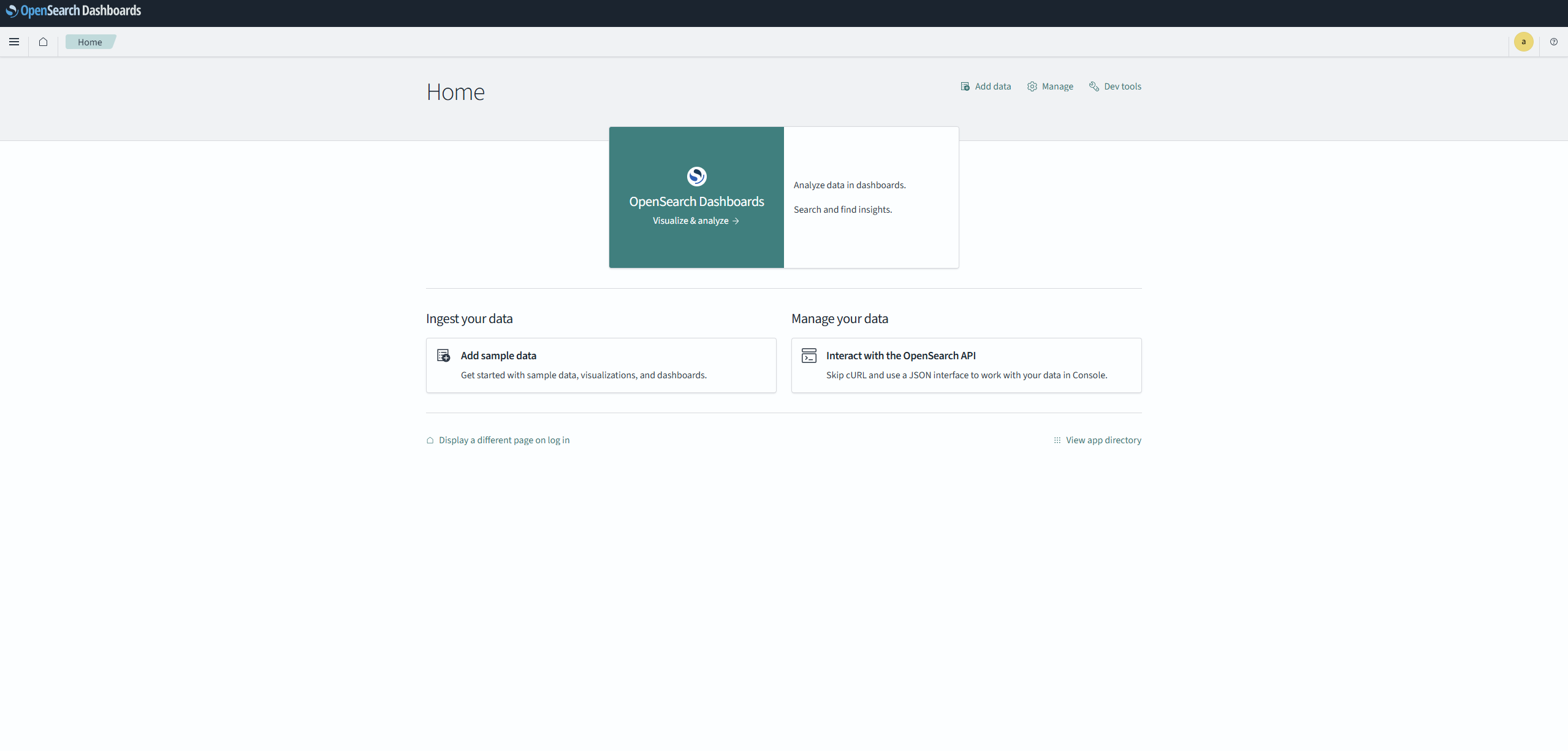
After logging in, UI will look like this:-